In 2024, Malaysians’ favorite social media platform, WhatsApp, emerged as the most widely used social media app among users aged 16 to 64, with a monthly usage rate of 90.7%.
On average, users open and interact with WhatsApp a staggering 852 times each month, significantly surpassing the interaction rates of other social media platforms, including TikTok.
Since Meta’s acquisition of WhatsApp, the platform has undergone significant transformations, particularly in facilitating business-customer interactions. Meta has introduced various features to enhance business connectivity with customers through WhatsApp.
These include the integration of a direct “WhatsApp” button on Facebook pages and posts, as well as the ability to direct customers to businesses’ WhatsApp accounts from ads.
One notable innovation, Click-to-WhatsApp Ads, was launched by Meta in 2023, aiming to foster deeper customer engagement and facilitate communication between businesses and their new audience.
With WhatsApp’s popularity and Meta’s continuous efforts to enhance its business capabilities, leveraging this platform can significantly impact customer engagement and overall marketing success.
If you’re interested in harnessing the vast potential of WhatsApp to engage your audience, we recommend checking out these informative articles:
WhatsApp Broadcasting: A Complete Guide for Beginners
Using WhatsApp Broadcasting for Marketing
SMS vs Whatsapp Marketing

What is Click-to-Whatsapp Ads (CTWA)?
In essence, CTWA incorporates a call-to-action button on your Facebook and Instagram ads, enabling customers to directly start a WhatsApp conversation with your business.
These ads can be placed across various segments on Facebook and Instagram, including News Feed, Stories, and Marketplace. This feature facilitates enhanced customer interaction, supports lead generation, and boosts sales and marketing efforts efficiently.

The Power of Click-to-WhatsApp Ads
Data, Data, Data
Click-to-WhatsApp ads are like a treasure trove of data, making them a marketer’s dream tool.
By tapping into Facebook and Instagram’s massive reach and precise targeting based on a myriad of criteria such as interests, age, and even relationship status, marketers can direct ads to people who are genuinely interested in your products and services!
Once a customer engages through a Click-to-WhatsApp ad, marketers gain valuable insights:
Entry Point: Identify how customers land on the chat.
Intent: Understand the reason behind the conversation initiation.
Ad Interaction: Determine which ad group led to the engagement.
Data Gathering: Collect insights during the chat, such as interests, product preferences, and location.
Purchase Status: Find out if the customer has made a purchase.
Gathering these insights means you can build a detailed customer profile, just like knowing your regulars by name and their usual orders.
This gives marketers a 360-view of the customer’s journey, enabling them to shift from bombarding them with ads to engaging them in meaningful conversations on WhatsApp, saving precious marketing ringgit.
And the best part? You’re capturing every lead, securing valuable info such as names and phone numbers, ensuring your sales funnel is as leak-proof as a well-packed coffee takeaway.
This approach not only cuts down on marketing spend but also personalizes the customer experience, making every interaction warm and welcoming.

Maximize Impact, Minimize Costs
Meta’s documentation highlights an interesting feature: when a user messages a business through a Click to WhatsApp ad, the initiated conversation will be free of charge for the first 72 hours.
This allows businesses to engage and re-engage with customers without incurring additional expenses, presenting a cost-saving opportunity that could be redirected towards future campaigns.
A notable case study revealed that 47% of customers showed a preference for contact through WhatsApp.
Leveraging this insight, a company employed Facebook Click to WhatsApp ads to connect with business owners, facilitating conversations with their remote sales team.
Within a span of just two months, this strategic move generated over 6,000 conversations. When comparing these efforts to other online conversion campaigns, it was found that the ads directed to WhatsApp achieved a cost per acquisition that was notably five times lower!

Elevate Customer Discoveries & Drive Sales
Click to WhatsApp ads are particularly effective for products or services that require demonstrations or persuasive efforts prior to purchase. They are an ideal choice in several scenarios:
For instances where customers require consultations before committing to a purchase, these ads facilitate real-time, personalized interaction.
They are also useful when detailed customer information is necessary to tailor orders specifically to an individual’s needs.
Additionally, when coordinating appointments, gathering customer preferences via this platform can streamline the scheduling process.
Lastly, Click to WhatsApp ads are beneficial for conducting surveys or leading generation campaigns, where interactions can be managed efficiently through a chatbot.

Click, Chat, Convert: How Businesses Are Striking Rich with CTWA
Lead Generation: EcoWorld Boosting Property Lead Generation with WhatsApp Ads
EcoWorld, a renowned Malaysian property developer, has turned to WhatsApp in an innovative strategy to enhance their lead generation. This savvy move involved deploying Click-to-WhatsApp ads across popular social media platforms like Facebook and Instagram.
The idea? To make it super easy for potential buyers to chat directly with a sales agent about the ins and outs of owning an EcoWorld property.
By casting a wide net and also zeroing in on potential homebuyers who’ve already interacted with EcoWorld online — be it through likes, shares, or visits — the company ensured that their sales team was chatting with people genuinely interested in making a purchase.
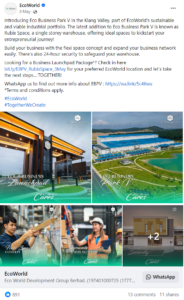
Source: EcoWorld
They racked up a whopping 15,000 clicks leading eager prospects to initiate chats on WhatsApp. Even more impressive, 21% of these interactions were with high-quality leads.
Ecoworld also saw returns up to 6.5 times their initial ad spend, thanks to the property bookings that followed.
This clever approach not only diversified EcoWorld’s ways of pulling in leads but also established a more personal connection with potential homeowners, guiding them smoothly along their buying journey.
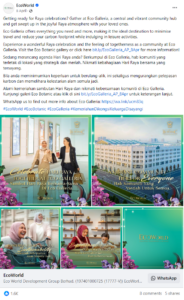
Source: EcoWorld
Conversion: How Vyatta Boosted Sales and Reduced Costs Using CTWA
Vyatta, an Indonesian company specializing in tech accessories, implemented CTWA through their Facebook ads, specifically targeting individuals who visited their Shopee store but hadn’t made a purchase in the last 60 days.
Here’s how it worked: customers interested in Vyatta’s products would click on the ad’s call-to-action (CTA) button. This action would open a chat in WhatsApp, where they were greeted with an automated welcome message.
For any inquiries, a Vyatta customer service representative was ready to engage, providing further details about the products. If the customer decided to make a purchase, they were directed back to Vyatta’s Shopee store to complete the transaction.
This approach yielded remarkable results for Vyatta. The adoption of Facebook ads with a direct click to WhatsApp feature led to a 5x increase in purchases and a 79% reduction in the cost per acquisition compared to their standard collaborative ads.

Click to Whatsapp with AdFortless!
Unlock the potential of direct customer engagement with Click-to-WhatsApp Ads (CTWA) and propel your business forward.
AdFortless specializes in integrating WhatsApp Business API and CTWA, offering a powerful solution that simplifies customer interactions, maximizes marketing efforts, and boosts sales.
Elevate your marketing strategy and forge stronger connections with your audience with the help of AdFortless. Start transforming leads into loyal customers today.